| BECKENHAM BOROUGH COUNCIL |
|
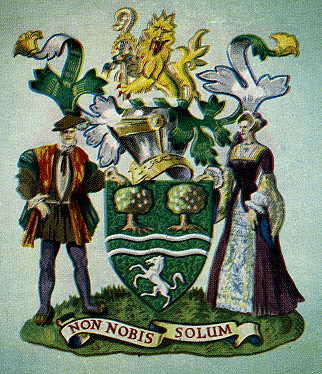
ARMS: Vert two Bars wavy Argent between as many Chestnut Trees in full blossom and eradicated proper in chief and a Horse forcene of the second in base. Motto 'NON NOBIS SOLUM' - Not for ourselves alone. Incorporated into the London Borough of Bromley in 1965. Picture used with permission, do not reproduce. |
 |
|
The green background, suggest the Beckenham of old, a township in a rural setting and modern Beckenham, with its parks and open spaces, to which the trees also refer. The wavy line represents the River Beck, echoing the name of the town, and the horse is from the arms of the County Council. |
| BEXLEY BOROUGH COUNCIL |
|
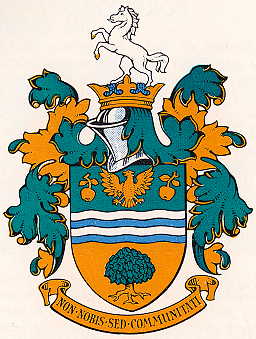
ARMS: Per fesse Vert and Or a Fesse wavy barry wavy of four Argent and Azure in chief an Eagle displayed between two Apples leaved and slipped of the second and in base an Oak Tree eradicated proper. Motto 'NON NOBIS SED COMMUNITAT' - Not for ourselves but for the community. Incorporated into the London Borough of Bexley in 1965. Picture used with permission, do not reproduce. |
 |
|
The basic colours of green and gold recall the Bexley of old, a township in a rural setting of green fields and waving corn. The eagle is from the arms of the first and only Lord Bexley, Nicholas Vansittart, who became Chancellor of the Exchequer in 1812. The apples recall the once famous fruit growing areas of East Wickham, Welling and Bexleyheath. The blue and white waves represent the area's rivers and streams and the oak tree the woodland, once extensive, that is still preserved in the open spaces of the Borough. |
| BROMLEY BOROUGH COUNCIL |
|
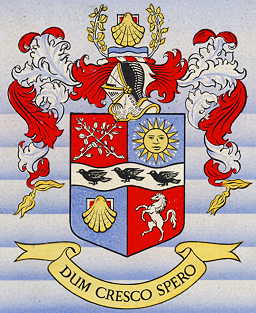
*ARMS: Quarterly Gules and Azure on a Fess wavy Argent three Ravens volant proper between in the first quarter two Branches of Broom in saltire Argent in the second quarter a Sun-in-splendour in the third quarter an Escallop Or and in the fourth quarter a Horse forcene Argent. Motto 'DUM CRESCO SPERO' - While I grow I hope. Incorporated into the London Borough of Bromley in 1965. |
 |
|
The sprigs of broom refer to the derivation of the name; 'a field or pasture where broom grows'. The sun recalls the once important Manor of Sundridge, owned in the reign of Henry III, by the Bland family. Sundridge continued in the family for sometime, eventually passing through different hands until Sir Claude Scott purchased it in 1796, and built the present mansion. The shell is from the arms of the See of Rochester, which held the Manor from the reign of Ethelbert, it is also the emblem of pilgrims and recalls the many roads and lanes in Kent, still called Pilgrims Road or Pilgrims Way along which they travelled. The horse is from the arms of the County Council and the wavy line and ravens refer to the River Ravensbourne. The river has its chief source in Caesar's Well at Keston, its name is supposed to be derived from the following legend: - Roman soldiers in great need of water saw a raven frequent a certain spot near their camp, upon examination a small spring was found among the bushes. Upon digging it out a copious spring was found. |
| CHATHAM BOROUGH COUNCIL |
|
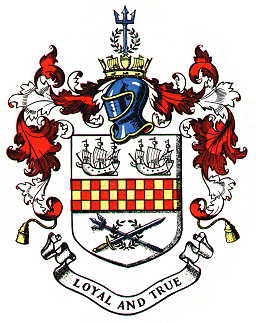
ARMS: Argent a Fesse chequy Gules and Or between in chief two ancient Ships with three masts and sails proper colours flying of the second and in base a Sword of the fourth pommel and hilt of the third surmounted by a Trident in saltire and entwined with a Wreath of Laural proper. Motto 'LOYAL AND TRUE'. |
 |
|
The chequered band is derived from the arms of William Pitt, the first Earl of Chatham, the colours have been changed to gold and red from the original blue and silver to denote Chatham's military associations. The ships and naval crown refer to the town's naval associations and the laurel wreath, trident and sword to the Royal Marines. |
| CRAYFORD URBAN DISTRICT COUNCIL |
|
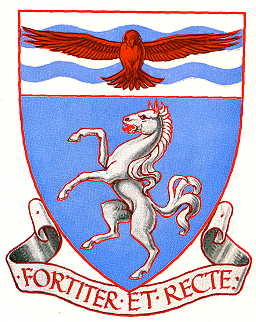
ARMS: Azure a Horse forcene Argent on a Chief of the last twp bars wavy of the field surmounted by a Falcon volant affrontée Gules. Motto 'FORTITER ET RECTE' - Boldly and rightly. Incorporated into the London Borough of Bexley in 1965. Picture used with permission, do not reproduce. |
 |
|
The horse is from the arms of the County Council and was also the standard of the Saxon chieftain Hengist, who reputedly defeated the Britons at Crayford. The two waves represent the rivers Thames and Cray, and the falcon recalls the first heavier than air flying machine, which was constructed by Sir Hiram Maxim and flown on rails in a field in Crayford in 1894. |
| DARTFORD BOROUGH COUNCIL (former) |
|
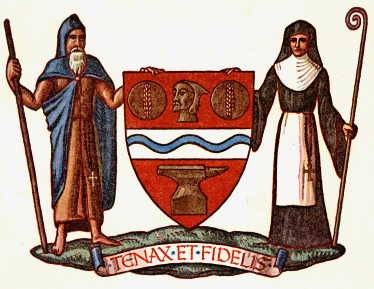
ARMS: Gules on a Fess Argent between in chief a Jester's Head habited in a Fool's Cap couped at the neck Or between two Bezants each charged with an Ear of Wheat proper and in base an Anvil of the third a Barrulet wavy Azure. Motto 'TENAX ET FIDELIS' - Steadfast and faithful. |
 |
|
The blue wave on the white fess represents the River Darent, from which the town of Dartford took its name. The paper-making industry is represented by the jester's head wearing a Fool's Cap. It is of interest in this connection to note that the emblem is found as a water-mark in paper as early as the reign of King Charles II. On either side are golden roundels, which are as near as heraldry permits to get to the familiar tabloids of our chemical factories. These are charged with ears of wheat, symbolizing another of the staple industries of the borough. The golden anvil at the base of the shield is emblematical of the great engineering and metal-working interests. |
| DARTFORD RURAL DISTRICT COUNCIL |
|
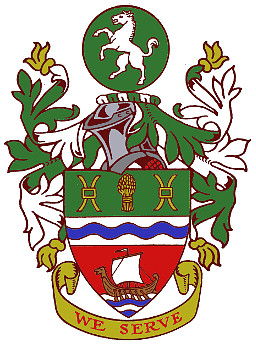
ARMS: Per fesse Vert and Gules on a Fesse Argent between in chief a Garb between two Millrinds Or and in base on Water barry wavy of the third and Azure an Ancient Glley in full sail oars in action proper a Bar wavy of the fifth. Motto 'WE SERVE'. |
 |
|
The wheatsheaves refer to agriculture, and the millrinds (iron clamps at the centre of millstones) represent agricultural engineering. The fess indicates the River Darent, and the ancient galley alludes to the Roman occupation of the district. |
| DEAL BOROUGH COUNCIL |
|
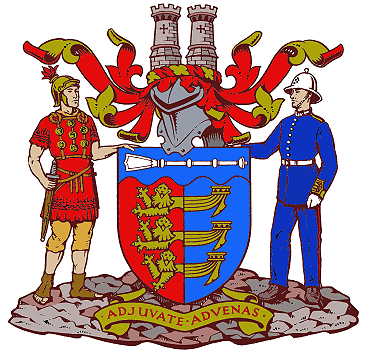
ARMS: Per pale Gules and Azure three demi Lions passant guardant in pale dimidiated with three demi Hulks of Ships Or on a Chief Azure a representation of the Silver Oar of the Cinque Ports. Motto 'ADJUVATE ADVENAS' - Befriend the stranger. |
 |
|
The arms are derived from the town's seal, in turn this was based upon the arms of the Cinque Ports, Deal being a non-corporate member of Sandwich. Deal's charter of incorporation in 1699 is unique within the Confederation in specifying that the town's seal should show the arms of the Cinque Ports. The silver oar is the symbol of the authority of the Admiral of the Cinque Ports. |
| ERITH BOROUGH COUNCIL |
|
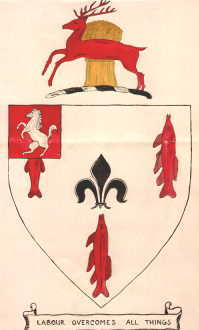
ARMS: Argent a Fleur-de-Lys Sable between three Lucies haurient two and one Gules on a Canton of the last a Horse forcene of the field. Motto 'LABOUR OVERCOMES ALL THINGS'. Incorporated into the London Borough of Bexley in 1965. Picture used with permission, do not reproduce. |
 |
|
The three pikes or lucies, recall the district's connection with Sir Richard de Luci, Lord of the Manor of Lesnes in the 12th century. He founded Lesnes Abbey, whose arms also incorporated lucies, in 1178 and was afterwards a Canon Regular there. The fleur-de-lys, also known as a fleur-de-luce, is a further play on the Luci name. The white horse on red is from the arms of the County Council, its position refers to Erith's location in the north west corner of Kent. |
| GILLINGHAM BOROUGH COUNCIL |
|
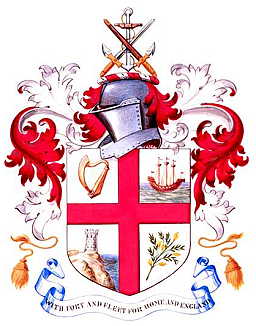
ARMS: Argent a Cross Gules in the first quarter an Ancient Harp in the second on Waves of the Sea an Ancient Ship in the third issuing out of Waves of the Sea a Rock thereon a Fort and in the fourth quarter a Sprig of Broom all proper. Motto 'WITH FORT AND FLEET FOR HOME AND ENGLAND'. Picture thanks to Laurence Jones. |
 |
|
The cross of St. George, the fort and the ship symbolise the idea summed up in the motto. The sprig of broom alludes to the district of Brompton. The crossed swords recall the battle fought in 1016 between Edmund Ironside and Canute. |
| GRAVESEND BOROUGH COUNCIL |
|
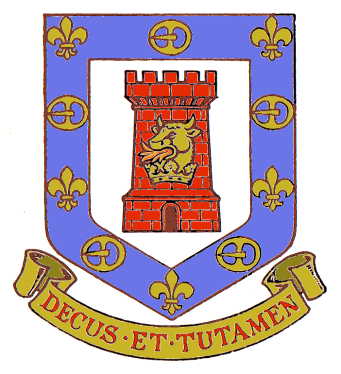
ARMS: Argent a Tower Gules charged with a Bull's Head issuing from a Ducal Coronet both Or and vomiting Flames of Fire proper all within a Bordure Azure charged with five Fleurs-de-Lys and as many Buckles Or. Motto 'DECUS ET TUTAMEN' - An honour and a protection. |
 |
|
The bull's head is from the old Portreeve's seal, which dates back to before 1574. The border of fleurs-de-lys and buckles was granted in 1635 to commemorate the honours bestowed upon the town by the Duke of Lennox. |
| HERNE BAY URBAN DISTRICT COUNCIL |
|
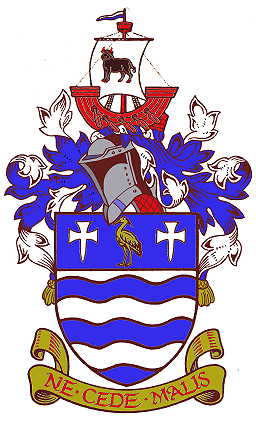
ARMS: Barry wavy of six Argent and Azure, on a Chief of the last a Heron Or between two Crosses formee fitchee of the first. Motto 'NE CEDE MALIS' - Yeild not to adversity. |
 |
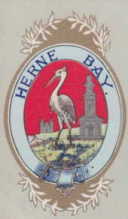 |
The blue and white waves are an obvious reference to the sea. The heron is allusive to the name, and was the device of the Council before the arms were obtained. The crosses, ecclesiastical emblems of Chist Church, denote the cathedral church of the Diocese and the parish church of Herie Bay. |
| MARGATE BOROUGH COUNCIL |
|
ARMS: Per pale Gules and Azure a Chevron Argent between in chief a demi Lion passant guardant conjoined to the demi-Hulk of a Ship Or and in base a Horse rampant of the third. Motto 'PORTA MARIS PORTUS SALUTIS' - . Picture taken from here. |
 |
|
The lion-hull is that of the Cinque Ports, as Margate was anciently a non-corporate limb of Dover. The white horse represents the county and the emblems on the crest are appropriate for a seaside town. |
| ORPINGTON URBAN DISTRICT COUNCIL |
|
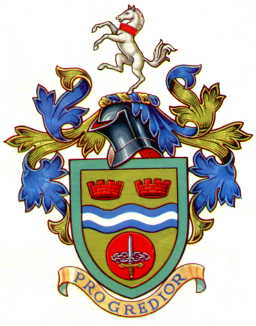
ARMS: Or a Fesse wavy Azure charged with a Barrulet wavy Argent in chief two
Mural Crowns Gules and in base a Torteau thereon a Sword erect proper pommel and hilt Gold the
blade enfiled with a Chain of Steel also proper and the whole within a Bordure Vert. Motto 'PROGREDIOR' - I progress. Incorporated into the London Borough of Bromley in 1965. Picture used with permission, do not reproduce. |
 |
|
The blue and white wave represents the River Cray, which has its source in the District, and the mural crowns symbolise the urban development in the northern and central parts of the District. The sword and chain are derived from the badge of the famous Royal Air Force Station at Biggin Hill. The green border represents the Green Belt around London, and symbolises the rural character of the extensive eastern and southern parts of the District, which lie within the Belt. |
| ROCHESTER CITY COUNCIL (former) |
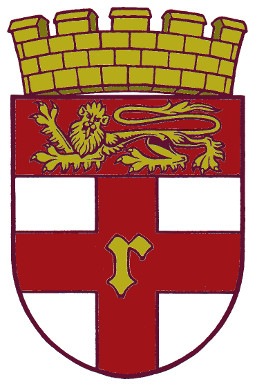 |
ARMS: Or on a Cross Gules a Letter R of the field on a Chief of the second a Lion passant guardant Gold.
Recorded as a seal device (untinctured) at the Visitation of 2nd September 1574. Recorded with tinctures (as Arms) at the Visitation of 1619. |
The lion recalls the Rochester was originally a royal borough. The arms are unusual for the inclusion of a letter of the alphabet. The red cross is probably that of St. George. The design was formerly used as a seal device, however the mural crown, a common symbol, of civic government was not recorded at either of the Visitations referred to above. |
| ROCHESTER UPON MEDWAY CITY COUNCIL |
|
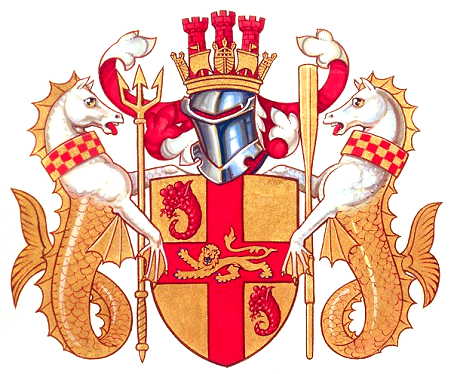
*ARMS: Or on a Cross between in the first and fourth quarters a Cornucopia Gules a Lion passant guardant of the first. Motto 'LOYAL AND TRUE'. The City of Rochester upon Medway was formed by the amalgamation of former City of Rochester, the Borough of Chatham and part of the Stood Rural District. It was originally called the Borough of Medway. |
 |
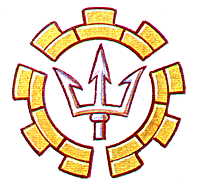 |
The red cross on gold, taken from the former City of Rochester arms, together with two cornucopiae, symbols of plenty, from the arms of Strood RDC. The gold lion of England, also used by Rochester to denote that it was once a royal borough, but now symbolising Medway's many royal connections. |
| ROYAL TUNBRIDGE WELLS BOROUGH COUNCIL (former) |
|
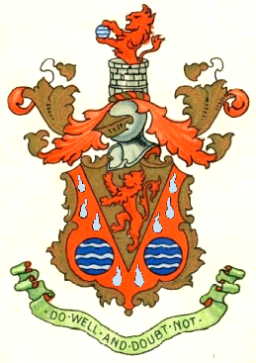
ARMS: Gules guttée d'Eau on a Pile Or between two Fountains in base a Lion rampant Gules. Motto 'DO WELL AND DOUBT NOT'. |
 |
|
The heraldic fountains, drops of water and the well-head all allude to the medicinal springs to which the town owes its name. The pile represents the geological fault which gives rise to those springs. The lions recall the Tunbridge Wells is officially styled 'Royal'. |
| SITTINGBOURNE AND MILTON URBAN DISTRICT COUNCIL |
|
ARMS: Or a Lion rampant Gules and a Wyvern rampant combatant Vert supporting a Scroll of Parchment erect proper on a Chief Azure a Saxon Crown between two Escallops of the field. Motto 'KNOWN BY THEIR FRUITS'. Picture used with permission, do not reproduce. |
 |
|
The gold background, the colour of royalty, refers to the area's royal connections, through the Royal Manor of Milton and the Elizabethan charters granted to Sittingbourne. The lion recalls the ancient Red Lion Inn, an important place on the Dover Road, especially in coaching days. Here Henry V is reputed to have been entertained on his triumphant return from Agincourt. The wyvern was used as a device by the Milton Regis UDC and the later Council before arms were granted. It indicated the defences made by the area's ancient inhabitants against Danish and later invaders. The scroll of parchment refers to industry, and the town's paper making industry in particular. The blue chief refers to water, which has played an important role in the life of the area, whether for ancient fisheries, navigation or modern industry. The Saxon crown indicates that Milton was was a royal manor as far back as the day's of King Alfred. The shells recall the the valuable fisheries of Milton, dating from the oyster fisheries in Roman days. Also as the emblem of a pilgrim, they refer to the fact that Sittingbourne was a stopping place on the road to St. Thomas à Becket's shrine at Canterbury. |
| SOUTHBOROUGH URBAN DISTRICT COUNCIL; See Southborough Town Council. |
| STROOD RURAL DISTRICT COUNCIL |
|
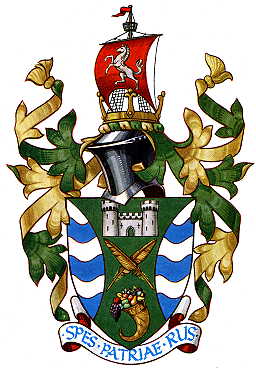
ARMS: Vert two Quill Pens in saltire Or between in Chief a Gateway flanked by two Towers Argent and in base a Cornucopia of the second two Flaunches barry wavy of six Argent and Azure. Motto 'SPES PATRIAE RUS' - The hope of the Country is the countryside. |
 |
|
The shield is a heraldic map of the District. The green central section represents the rich agricultural area of the Rural District, particularly the Hoo Peninsula; between blue and white waves representing the rivers Thames and Medway. The gateway refers to Cooling Castle and the quill pens refer to the area's literary associations with Charles Dickens. The Cornucopia stands for agriculture, the principal industry. |
| TONBRIDGE URBAN DISTRICT COUNCIL |
|
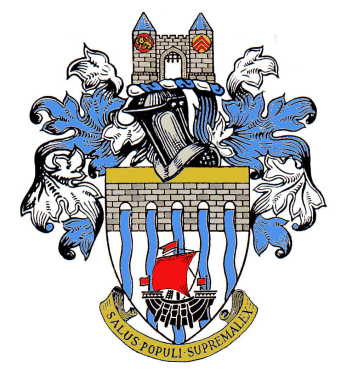
ARMS: Argent five Pallets wavy Azure a Chief Or over all a Bridge of five arches masoned proper and in base an Ancient Ship with oars Sable sail set and colours flying Gules. Motto 'SALUS POPULI SUPEREMA LEX' - The good of the people is the supreme law. |
 |
|
The bridge of five arches and the five streams represent the five waterways that once crossed Tonbridge High Street, three of which have now been culverted. The ship imposed across these implies the importance to Tonbridge of the making navigable of the River Medway, particularly before the coming of the railway. |
|
|
|
|