|
ABERCONWY BOROUGH COUNCIL ~ CYNGOR BWRDEISTREF ABERCONWY (GWYNEDD) |
|
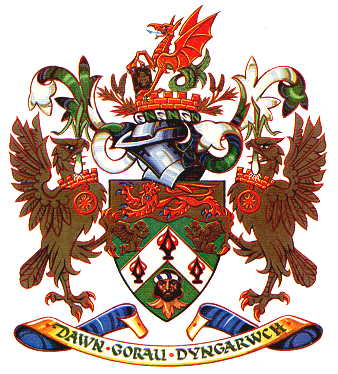
ARMS: Vert on a Chevron Argent between in chief two Angels kneeling in prayer respectant Or and in base a Saracen's Head erased affrontee proper wreathed about the temples Argent and Azure three Spearheads Sable embrued proper on a Chief wavy Or a Lion passant guardant Gules. Motto 'DAWN GORAU DYNGARWCH' - The greatest virtue is philanthropy. The Borough of Aberconwy was formed by the amalgamation of the Borough of Conwy, the Betws-Y-Coed Urban District, the Llandudno Urban District, the Lanfairfechan Urban District, the Llanrwst Urban District, the Penmaenmawr Urban District, part of the Aled Rural District, part of the Hiraethog Rural District and the Nant Conwy Rural District. |
 |
|
The shield illustrates the topography and history of the district through the traditional heraldry of the tribal chiefs whose territories largely covered the Borough's area. The green background and wave denote the Conwy valley. The angels are for Maeloc Crwm (Llechwedd and Creuddyn), the spearheads for Nefydd Hardd (Nant Conwy), the Saracen's head for Marchudd ap Cynan (Rhos and Abergele), and the lion for the Princes of Gwynedd, Dafydd and Llywelyn the Great (Betws y Coed). |
|
ALYN AND DEESIDE DISTRICT COUNCIL ~ CYNGOR DOSBARTH ALUN A GLANNAU DYFRDWY (CLWYD) |
|
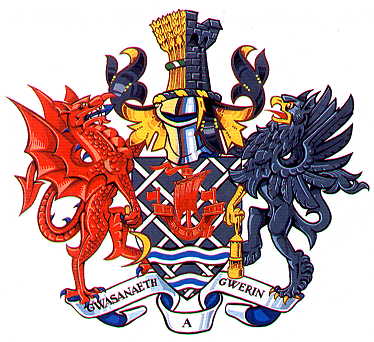
ARMS: Sable fretty Argent over all Lymphad Gules in base two Barrulels wavy Argent each charged with a like Barrulet Azure. Motto 'GWASANAETH A GWERIN' - Service and people. The Alyn and Deeside District was formed by the amalgamation of the Buckley Urban District, the Connah's Quay Urban District and part of the Hawarden Rural District. |
 |
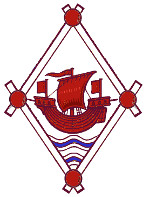 |
The pattern of interlaced white bars on a black background conveys the impression of the coal-mining interests plus the engineering activities at Shotton and Broughton. Over this pattern is a galleon, like that in the arms of the Connah's Quay UDC, on a symbolic sea. The two bars can also be seen as reprsenting the rivers Dee and Alyn. |
|
BRECKNOCK BOROUGH COUNCIL ~ CYNGOR BWRDEISTREF BRYCHEINIOG (POWYS) |
|
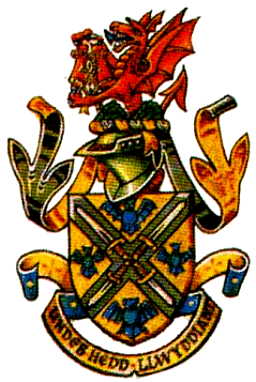
ARMS: Or on a Saltire Sable between four Reremice affrontée Azure four Swords points outwards Argent pommels and hilts Or. Motto 'UNDEB HEDD LLWYDDIANT' - Unity, peace, success. The Borough of Brecknock was largely coterminious with the former County of Brecknockshire. Picture and information courtesy of Laurence Jones. |
 |
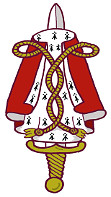 |
The arms are based on the insignia used by the former Brecknockshire CC, which had adopted the attributed arms of the Hiberno-Welsh Chieftain Brychan. A fifth century founder of Brycheiniog, under whose leadership the Goidels reoccupied the Usk Valley on the withdrawal of the Romans. The shield was quartered. In the first and fourth quarters were the purported arms of Brychan's father Anlach and in the second and third quarters were arms representing Brychan's mother, Marchell. The swords on black are for Prince Anlach, Brychan's father and the blue reremice or bats on gold are for Marchell, his mother. From Brychan was derived the name Brycheiniog, now Brecknock. The colours of gold and black are symbolic of agriculture and industry, especially coal-mining, which are typical of the area. |
|
CARMARTHEN DISTRICT COUNCIL~ CYNGOR DOSBARTH CAERFYRDDIN (DYFED) |
|
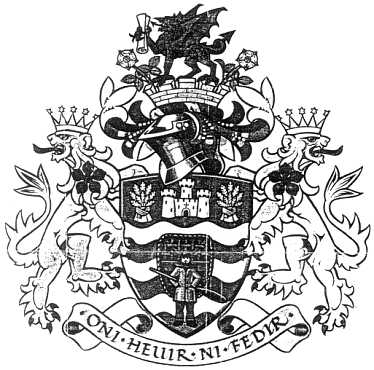
ARMS: Barry wavy of six Argent and Azure a Fisherman affronty bearing on his back a Coracle with Oar proper on a Chief wavy Vert a Castle of three towers
Argent between two Garbs Or. Motto 'ONI HEUIR NI FEDIR' - One must reap before one sows. The Carmarthen District was formed by the amalgamation of the Borough of Carmarthen, the Newcastle Emlyn Urban District, the Carmarthen Rural District and the Newcastle Emlyn Rural District. Picture and information courtesy of Laurence Jones. |
 |
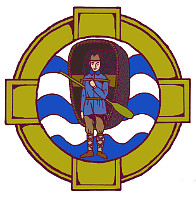 |
The field consisting of six waves suggests the rivers and coastline of the District. The coracle fisherman was the crest of the former Borough of Carmarthen (now used by Carmarthen Town Council). A similar figure appeared on the medallion of Newcastle Emlyn RDC and on the front of the official guide to Carmarthen RDC, so it was an obvious choice as an emblem for the area. The chief bears a castle from the former Borough's arms, flanked by two garbs from the arms of Carmarthen RDC. The castle also represents other fortresses in the District such as Newcastle Emlyn, Laugharne and Llanstephan. The castle also represents the Borough and Urban District, and the garbs the two Rural Districts which were combined to form the new council's area. The chief is coloured green for agriculture and dairy farming. |
|
CLWYD COUNTY COUNCIL ~ CYNGOR SIR CLWYD |
|
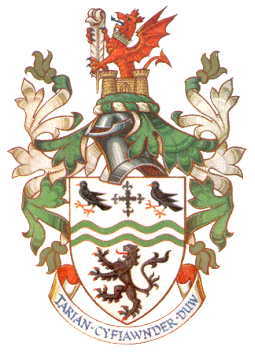
ARMS: Argent on a Bar wavy Vert between in chief a Cross fleuretty engrailed Sable between two Choughs proper and in base a Lion rampant Sable a Barrulet wavy Argent. Motto 'TARIAN CYFIAWNDER DUW'- The County of Clwyd was formed in 1974 from Denbighshire and Flintshire. |
 |
|
The green and white wave represents the Vale of Clwyd and the Clwydian hills lying between the two counties former constituent counties of Flintshire and Denbighshire. The
cross and choughs from the Flintshire shield come from the traditional arms of Edwin of Tegeingl, founder of the twelfth Noble Tribe of North Wales. The black lion of the Princes of Powys Fadog comes from the Denbighshire shield. |
|
COLWYN BOROUGH COUNCIL ~ CYNGOR BWRDEISTREF COLWYN (CLWYD) |
|
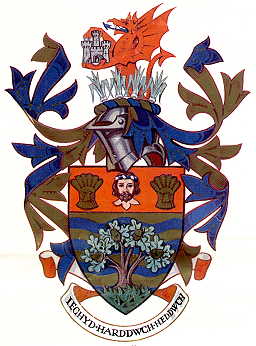
ARMS: Barry wavy of eight Or and Azure on a Mount in base issuant an Oak Tree proper fructed Or on a Chief
Gules between two Garbs Or a Saracen's Head afrontee erased proper wreathed about the temples Argent and Azure. Motto 'IECHYD HARDDWCH HEDDWCH' - Health, beauty, tranquillity. |
 |
|
The background of gold and blue waves represents the coastal areas, overlying these is the oak tree with gold acorns from the arms and former seal of the Borough of Colwyn Bay. The Saracen's head is from the heraldry of Marchudd ap Cynan, Founder of the VIII Noble Tribe of North Wales and Lord of Abergele and Rhos. It was the device of Abergele UDC and is here shown on its correct field of red, flanked by two gold wheatsheaves for the Rural Districts of Aled and Hiraethog. |
|
CYNON VALLEY BOROUGH COUNCIL ~ CYNGOR BWRDEISTREF CWM CYNON (MID GLAMORGAN) |
|
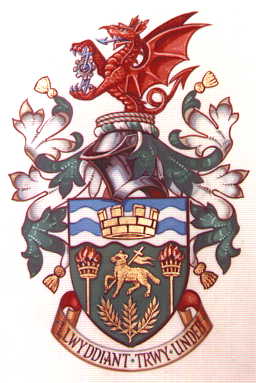
*ARMS: Vert between in base three Fronds of Mountain Ash conjoined and in the flanks two Cressets Or fired proper a Pascal Lamb also Or on a Chief wavy barry wavy of four Azure and Argent a Mural Crown Gold. Motto 'LLWYDDIANT TRWY UNDEB' - Success through union. The Borough of Cynon Valley was formed by the amalgamation of the Aberdare Urban District, the Mountain Ash Urban District, part of the Neath Rural District and part of the Vaynor and Penderyn Rural District. |
 |
|
The green background represents the hills and valleys. The Pascal Lamb is an emblem of St. John the Baptist, to whom
the ancient church at Aberdare is dedicated. Mountain Ash is denoted by three fronds of the tree of that name. The two 'cressets' or fire baskets filled with blazing coal, recall the former coal and iron industries of the valley in which the parishes of Rhigos and Penderyn were also involved. Such a cresset appeared in the former Vaynor and Penderyn RDC arms in reference to these industries and to the Brecon Beacons and is the emblem of the Brecon Beacons National Park, part of which is in the Borough area. All the emblems are in gold, denoting prosperity and mineral wealth, and are placed in topographical order. The upper part of the shield symbolises the overall authority of Cynon Valley. The four blue and white waves for the four former areas and the four rivers - Cynon, Taff, Dâr and Hepste, overlaid by a gold mural crown, ancient emblem of local government, showing four battlements, again for the four former authorities. |
|
DELYN BOROUGH COUNCIL ~ CYNGOR BWRDEISTREF DELYN (CLWYD) |
|
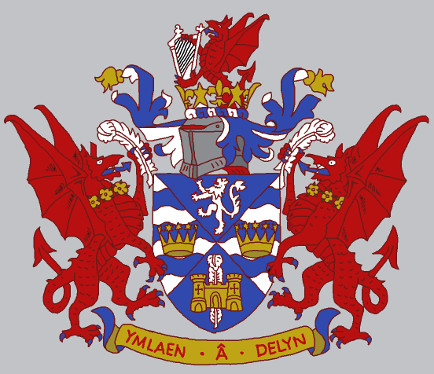
ARMS: Per saltire Azure and Argent in chief a Lion rampant Argent in each flank three Bars wavy Azure surmounted by a Celestial Crown Or and in base in front of an Ostrich Feather erect Argent a Castle of two Towers Or. Motto 'YMLAEN Â DELYN' - Forward with Delyn. The Borough of Delyn was formed by the amalgamation of the Borough of Flint, the Holywell Urban District, the Mold Urban District and the Holywell Rural District. |
 |
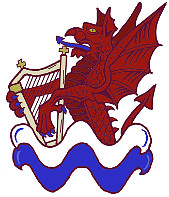 |
The white and blue waves, like those the arms of the Flint County Council, represent the rivers Dee and Alyn from which the Borough is named. The waves, with the golden celestial or saintly crowns, also refer to the Holy Well of St. Winefride and thus to the two Holywell Councils. The golden castle and white ostrich feather are taken from the civic badge of the Borough of Flint. The castle is derived from the old Borough Seal and the feather is that of Edward the Black Prince, who held Flint Castle and granted the town one of its Charters. It is shown on a blue background as in the Flint shield. The white lion on blue is that of the de Montalt family, long used with the ostrich feathers in the device of Mold UDC. Roger de Montalt was Seneschal to the Earls of Chester in the late 13th century and took his name from the 'high hill' or 'Mont hault' on which stood his castle, a name which became 'Mold'. |
|
DINEFWR BOROUGH COUNCIL ~ CYNGOR BWRDEISTREF DINEFWR (DYFED) |
|
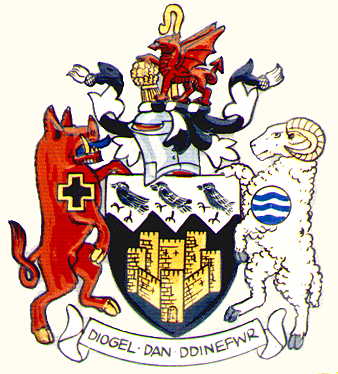
ARMS: Sable a Castle of five Towers in perspective in pentagon two two and one Or on a Chief dancetty of three points downward Argent as many Ravens close Sable. Motto 'DIOGEL DAN DDINEFWR' - Safe under Dinefwr. The Borough of Dynefwr was formed by the amalgamation of the Borough of Llandovery, the Ammanford Urban District, the Cwmamman Urban District, the Llandeilo Urban District and the Llandeilo Rural District. |
 |
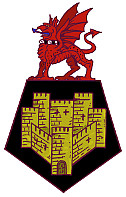 |
The pattern of the shield was suggested by the arms of the Ammanford UDC, with a black background and a zig-zag line of 'peaks' indicating the Black Mountains. On the black is a stylized gold castle of five towers, shown in perspective. This represents Dinefwr through its castle, and the five towers symbolize the union of five former authorities in the Borough. The three ravens on white are from from the legendary arms of Urien Rheged, reportedly one of King Arthur's Knights, whose castle is at Carregcennen and whose descendants include the famous Sir Rhys ap Thomas, the Lords Rhys and the present Lords Dynevor. |
|
DYFED COUNTY COUNCIL ~ CYNGOR SIR DYFED |
|
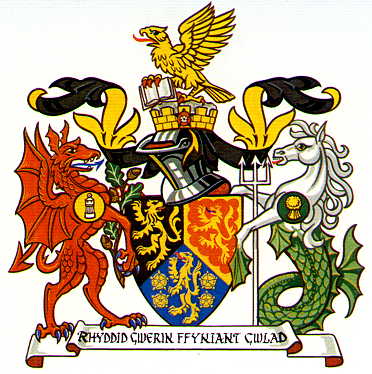
ARMS: Per pall reversed Sable Gules and Azure in the first a Lion rampant regardant in the second a Lion rampant within a Bordure engrailed and in the third a Lion rampant between four Roses all Or. Motto 'RHYDDID GWERIN FFYNIANT GWLAD'- The County of Dyfed was formed in 1974 from the counties of Cardiganshire, Carmarthenshire and Pembrokeshire. |
 |
|
The golden lion rampant regardant on a black ground is for Gwaethfoed, Prince of Ceredigion, and is from the arms of the former Cardiganshire County Council. The golden lion rampant on a red ground within a golden border is for Rhys ap Tewdwr, Prince of Deheubarth, and is from the arms of the former Carmarthenshire County Council. The a golden lion rampant between golden roses on a blue ground, represents Gwynfardd, Prince of Dyfed, whose seat was in Pembrokeshire. The whole signifies the earliest form of local government in the area, represented today by
Dyfed County Council, a tradition of over a thousand years. |
|
GLYNDWR DISTRICT COUNCIL ~ CYNGOR DOSBARTH GLYNDWR (CLWYD) |
|
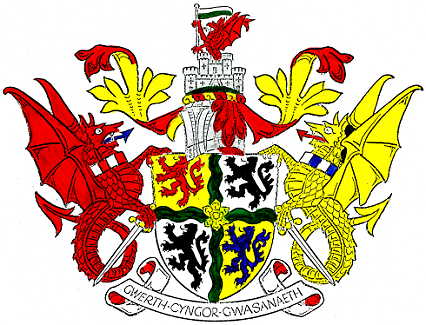
ARMS: Quarterly Or and Argent a Cross wavy Vert surmounted of a Daffodil Flower Or between in the first quarter a Lion Gules in the second and third a Lion Sable and in the fourth a Lion Purpure all rampant. Motto 'GWERTH CYNGOR GWASANAETH' - The virtue of a Council is its service. The Gyndwr District was formed by the amalgamation of the Borough of Denbigh, the Borough of Llangollen, the Borough of Ruthin, the Ceiriog Rural District, the Edeyrnion Rural District, the Llangollen Rural District and part of the Wrexham Rural District. |
 |
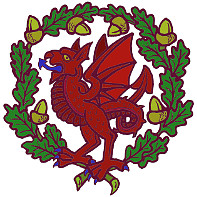 |
The shield is based on the arms adopted by Owain Glyndwr for his Great Seal - a quartered shield with four lions rampant. It in generally considered that the
colours were probably the same as those of the shield of Llywelyn the Great - gold and red quarters with the lions in opposite colours. This would be consistent with the descent of Owain from Bleddyn ap Cynfyn, King of Powys, to whom were attributed a red lion on gold. As a scion of the House of Powys Fadof Owain previously bore the Black Lion of Powys as seen in the former Denbighshire shield and the new Clwyd shield. In the shield, the first and fourth quarters are gold and the second and third are white. In the first quarter is Owain's red lion, and in the second his black lion. The latter is seen again in the third quarter for Owain's kinsman Owain Brogyntyn, Lord of Edeyrnion, whose area has come into the District from Meirionnydd. In the fourth quarter is the purple lion of the de Lacys, who built Denbigh Castle and were Marcher Lords of Rhyfoniog and Lords of Denbigh. A shield with a lion in the seal of the Borough of Denbigh is probably that of Henry de Lacy. Thus, the lions represent virtually all the districts of Glyndwr as well as the name. The wavy cross represents the four main rivers which flow across Glyndwr - Clwyd, Clywedog, Dee and Ceiriog. The cross is green to suggest the vales through which the rivers flow. At the centre of the cross is a gold Welsh daffodil flower, its six petals symbolizing the six complete districts comprised in Glyndwr. |
|
GWENT COUNTY COUNCIL See Monmouthshire County Council. |
|
GWYNEDD COUNTY COUNCIL ~ CYNGOR SIR GWYNEDD |
|
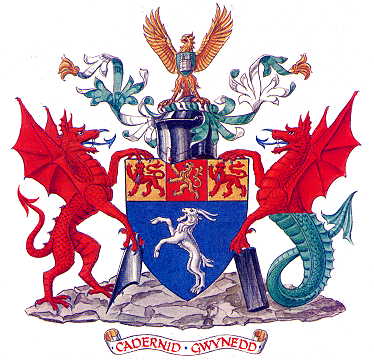
ARMS: Azure a Goat salient Argent on a Chief Or on a Pale between two Lions passant guardant Gules a Lion rampant Or. Motto 'CADERNID GWYNEDD' - The strength of Gwynedd. The County of Gwynedd was formed by the amalgamation of the County of Anglesey, the County of Caernarfonshire, part of the County of Merionethshire and part of the County of Denbighshire. |
 |
|
The two red lions passant on a gold background come from the arms of Caernarfonshire CC, the single golden lion rampant on a red background in the centre from the arms of Anglesey CC, with the goat on the blue background underneath coming from the Merioneth CC arms. |
|
ISLWYN BOROUGH COUNCIL ~ CYNGOR BWRDEISTREF ISLWYN (GWENT) |
|
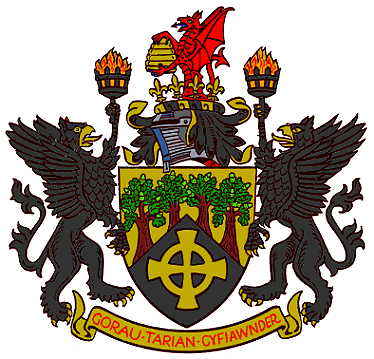
ARMS: Per chevron Or and Sable in chief four Oak Trees issuant fructed proper and in base the Head of a Celtic Wheelcross. Motto 'GORAU TARIAN CYFIAWNDER' - The best shield is justice. The Borough of Islwyn was formed by the amalgamation of the Abercarn Urban District, part of the Bedwellty Urban District, the Mynyddislwyn Urban District and the Risca Urban District. |
 |
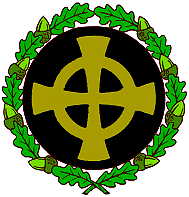 |
The shield refers to the name 'Islwyn' taken from Mynyddislwyn mountain, from which the poet, Aneurin Fardd's pupil took his pseudonym. The division 'per chevron' suggests a mountain with gold for agriculture, and black for coal. The well wooded slopes of the local hills are suggested by the four stylised oak trees growing out of the mountain, one for each of the four constituent areas. The oaks also recall several local names - Oakdale, Welsh Oak, and refer to the grove contained in the name Islwyn (below the grove or bush). The legend
of the siting of Mynyddislwyn Church 'below the grove' is symbolised by a plain Celtic wheelcross head in gold, below the trees. Its four arms joined by a ring also suggest the four former authorities joined in a single community. |
|
LLANELLI BOROUGH COUNCIL ~ CYNGOR BWRDEISTREF LLANELLI (DYFED) |
|
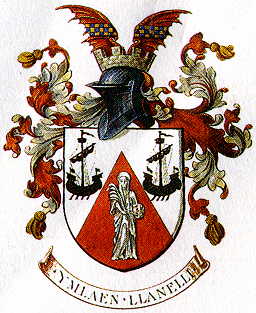
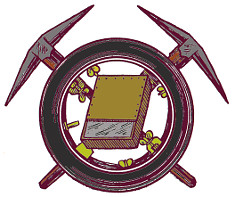
ARMS: Per chevron Argent and Gules in chief two Lymphads Sable and in base a figure representing St. Elli of the first. Motto 'YMLAEN LLANELLI' - Forward Llanelli. The Borough of Llanelli was formed by the amalgamation of the Borough of Kidwelly, the former Borough of Llanelli, the Burry Port Urban District and the Llanelli Rural District. |
 |
 |
The town derives its name from the Church of St Elli, a grand-daughter of Brychan (see Brecknockshire). She is reputed to have been martyred by the heathen Saxons. The ships stand for the port. |
|
LLIW VALLEY BOROUGH COUNCIL ~ CYNGOR BWRDEISTREF DYFFRYN LLIW (WEST GLAMORGAN) |
|
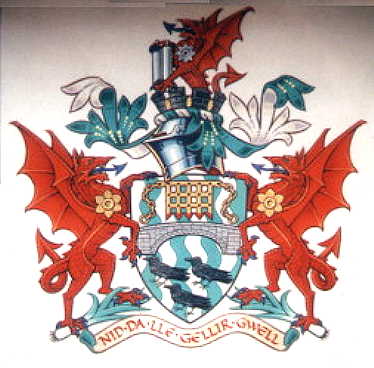
ARMS: Paly wavy of eight Argent and Vert in fess a representation of the bridge at Pontardawe throughout proper between in chief a Portcullis chained Or nailed Sable pointed Gules and in base three ravens close proper. Motto 'NID DA LLE GELLIR GWELL' - Though good is good, better is better (There is always room for improvement). The Borough of Lliw Valley was formed by the amalgamation of the Llwchwr Urban District and the Pontardawe Rural District. |
 |
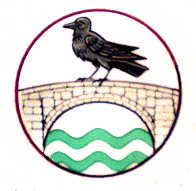 |
The background of eight alternate white and green waves running vertically, suggests the topographical area with its green valleys and four principal rivers - Lliw, Loughor, Clydach and Tawe. The portcullis is from the crest of the Dukes of Beaufort, former lords of the Borough of Loughor, while the three ravens are considered to be derived from the arms attributed by the mediaeval heralds to Urien Rheged, a 6th century prince or local chieftain who built his residence at Loughor, and whose descendants, the Rhys family of Dynever, still bear the ravens in their arms. The portcullis and ravens both appeared the old seal of the Borough. The bridge is that of Pontardawe, which is part of the insignia of Pontardawe RDC. |
|
MEIRIONNYDD DISTRICT COUNCIL ~ CYNGOR DOSBARTH MEIRIONNYDD (GWYNEDD) |
|
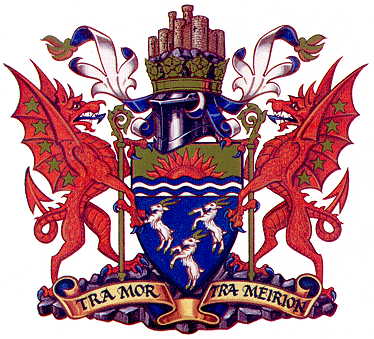
ARMS: Azure three Goats salient Argent armed crined and unguled Or on a Chief of the last issuant from barry wavy of four of the first and second a Sun rising Gules. Motto 'TRA MÔR TRA MEIRION' - Meirion will last so long as there is a sea. The Meirionnydd District was formed in 1974 from the County of Merioneth. |
 |
|
The shield is based on the arms that have been associated with Meirionnydd for many years. According to a manuscript formerly at Dolforgan a coat of arms was given for Merioneth, consisting of three white goats, salient (that is rearing on the hind-legs), with a gold sun in the base of a blue shield. This would appear to have a connexion with the fanciful arms given for Merioneth in Drayton's "Battle of Agincourt", where the men of the county bore a banner with "three goats dancing
'gainst a rising sun". It is difficult to say what this device was intended to signify, unless it was connected with the dominance of Cader Idris, upon which goats certainly lived and behind which the rising sun might be seen from certain viewpoints. The current arms preserve the original goats on their blue ground, but the sun has been moved to the top of the shield, shown setting red in a golden sky over blue and white waves. This stylised sunset is more in keeping with Meirionnydd's geographical situation than a rising sun would be; moreover, it was felt that the sea ought to be represented in the most important part of the arms, in regard to the traditional motto. |
|
MID GLAMORGAN COUNTY COUNCIL ~ CYNGOR SIR MORGANNWG GANOL |
|
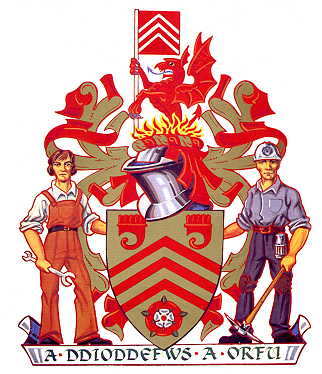
ARMS: Or three Chevronels between in chief two Clarions and in base a Rose Gules charged with a like Rose Argent both barbed and seeded proper. Motto 'A DDIODDEFWS A ORFU' - He who suffers, conquers. |
 |
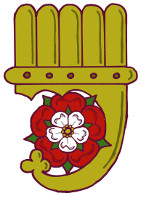 |
The three red chevronels on a gold ground are the arms of the de Clare family, Norman lords of the medieval marcher lordship of Glamorgan. This shield formed the basis of the arms of the former Glamorgan County Council, to which were added three Tudor roses, symbolic of the creation of the shire by Henry VIII in 1536. Mid Glamorgan retains one of these roses, to symbolise its emergence from the old county. The two clarions perpetuate the de Clare's badge, a playful pun upon their name. |
|
MONMOUTH BOROUGH COUNCIL ~ CYNGOR BWRDEISTREF MYNWY (GWENT) |
|
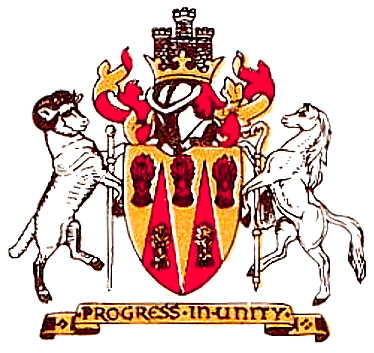
ARMS: Or two Piles reversed Gules five Garbs all counterchanged. Motto 'PROGRESS IN UNITY'. The Borough of Monmouth was formed by the amalgamation of the Borough of Abergavenny, the former Borough of Monmouth, the Chepstow Urban District, the Usk Urban District, the Abergavenny Rural District, the Chepstow Rural District, the Monmouth Rural District and most of the Pontypool Rural District. |
 |
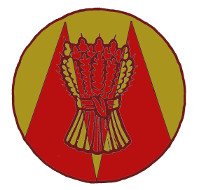 |
The two reversed piles suggest the initial letter "M" for Monmouth, the sheaves refer to agriculture. The castle refers to the area's many historic castles - Chepstow, Raglan, Abergavenny and Caldicot. The supporters again refer to farming and the bourdon and crozier to the area's religious foundations - Tintern Abbey and Llanthony Priory. |
|
MONTGOMERYSHIRE DISTRICT COUNCIL ~ CYNGOR DOSBARTH SIR DREFALDWYN (POWYS) |
|
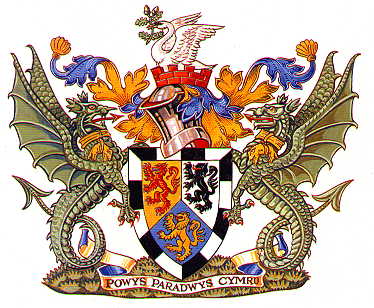
ARMS: Tierced in pairle reversed Or Argent and Azure three Lions rampant Gules Sable and Gold all within a Bordure gobony Sable and Argent. Motto 'POWYS PARADWYS CYMRU' - Powys paradise of Wales. The Montgomeryshire District was coterminious with the former Montgomeryshire County. |
 |
|
The two upper divisions represent the principalities of Powys Wenwynwyn and Powys Fadog, which in the Middle Ages covered largely what is now Montgomeryshire. The red lion on gold was the traditional arms of Gwenwynwyn and the black lion on white those of Madog, the two respective Princes descended from Bleddyn ap Cynfyn, last Prince of Powys. The gold lion on blue is from the arms of Roger de Montgomery, Earl of Shrewsbury, a leader of the Norman invasion of Wales, from whom the town and county take their name. The black and white border is derived from the colours of Brochwel Ysgithrog, a 7th century Prince of Powys famous for his resistance to the Saxons. |
|
NEATH BOROUGH COUNCIL ~ CYNGOR BWRDEISTREF CASTELLNEDD (WEST GLAMORGAN) |
|
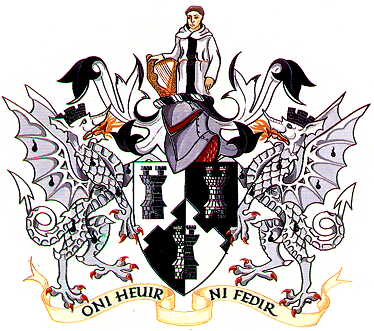
ARMS: Per chevron embattled and per pale Argent and Sable three Towers twin-turreted all counterchanged. Motto 'ONI HEUIR NI FEDIR' - He who does not sow does not reap. The Borough of Neath was formed by the amalgamation of the former Borough of Neath and the Neath Rural District. |
 |
|
The design of the Shield is based on the old Seal and arms of the former Borough of Neath which had a distinctive double-turreted tower. The basic colours of the Shield are black and white or silver. The black refers to the coalmining and oil industries whilst the white or silver refers to the metal industries once so prevalent in the Borough. |
|
PORT TALBOT BOROUGH COUNCIL ~ CYNGOR BWRDEISTREF PORT TALBOT (WEST GLAMORGAN) |
|
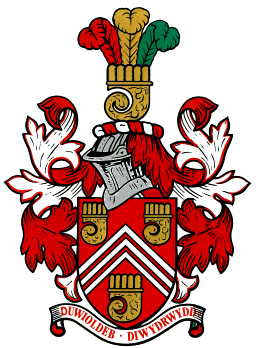
ARMS: Gules three Chevronels Argent between as many Clarions Or. Motto 'DUWIOLLDEB DIWYRDWYDD' - Godliness and industry. The Borough of Port Talbot was formed (originally as the Borough of Afan) by the amalgamation of the former Borough of Port Talbot and the Glyncorrwg Urban District. |
 |
|
The three silver chevronels are from the arms ascribed to the Iestyn family, and refer to the conferring of the original franchise by Caradoc ap Iestyn (1079-1148). This family were the Lords of Avan at the time of the Norman Conquest of Wales, following which the only Welsh Lordship having access to the sea was that of Avan. This Lordship, with its hinterland, was held by the senior descendant of Iestyn. The three gold clarions are the arms generally attributed to Robert Consul and William Earl of Gloucester (his son). Robert (the natural son of Henry I, who died in 1147), in granting the foundation Charter of Margam Abbey, gave all the lands between the Kenfig and Avan rivers to the Monks of Clairvaux, which Charter was confirmed by his son, William, who was a benefactor of Margam Abbey. |
|
PRESELI PEMBROKESHIRE DISTRICT COUNCIL ~ CYNGOR DOSBARTH PRESELI SIR BENFRO (DYFED) |
|
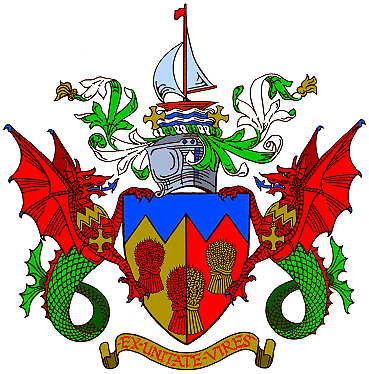
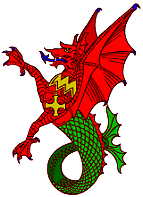
ARMS: Per pale Or and Gules three Garbs counter-changed a Chief indented Azure. Motto 'EX UNITATE VIRES' - Out of unity strength. The Preseli Pembrokeshire District was formed by the amalgamation of the Borough of Haverfordwest, the Fishguard and Goodwick Urban District, the Milford Haven Urban District, the Neyland Urban District, the Cemaes Rural District and the Haverfordwest Rural District. |
 |
 |
The indented blue chief refers symbolically to the Preseli Hills as seen against a blue sky. The sheaves of corn are partly coloured gold and red against a counter-changed background in order to symbolise the wealth which comes from agriculture and also the sweat and work which must go into it before it gives its returns. |
|
RADNORSHIRE DISTRICT COUNCIL ~ CYNGOR DOSBARTH SIR FAESYFED (POWYS) |
|
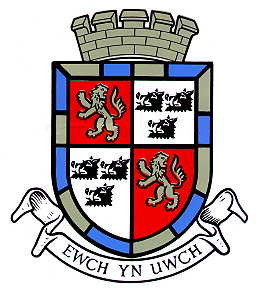
ARMS: Quarterly first and fourth Gules a Lion rampant reguardant Or second and third Argent three Boars' Heads couped Sable all within a Bordure compony of the second and Azure; the Shield ensigned with a Mural Crown Or. Motto 'EWCH YN UWCH' - Higher and higher. The Radnorshire District was coterminious with the former Radnorshire County. |
 |
|
The lion is attributed to Elystan Glodrhydd, a Prince of Wales about 1000, and the boars' heads are associated with his son Cadwgan. The border is from the arms of the Mortimer family, Earls of March. |
| RHONDDA BOROUGH COUNCIL (MID GLAMORGAN) |
|
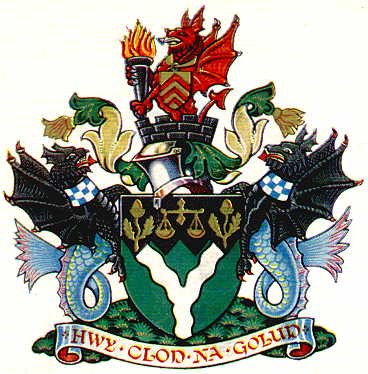
ARMS: Vert a Pall wavy Argent on a Chief indented Sable a Balance between two Acorns leaved and slipped
Or. Motto 'HWY CLOD NA GOLUD' - Fame outlasts wealth. |
 |
|
The green field, white wavy Y-shaped pall and the indented line suggest the Rhondda Valley, rivers and mountains. The black portion is for coal mining against which is a gold balance, for the more balanced industry of recent years. The gold acorns refer to the ancient forest and the growing new industries. |
| RHUDDLAN BOROUGH COUNCIL (CLWYD) |
|
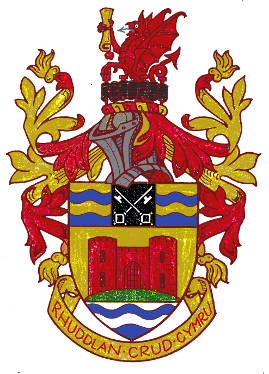
ARMS: Or issuant from a Base barry wavy of four Argent and Azure a Mount Vert thereon an Edwardian Castle of two Towers Gules on a Chief barry wavy of four Or and Azure a Pale Sable thereon two Keys in saltire wards upward and outward Argent. Motto 'RHUDDLAN CRUD CYMRU' - Rhuddlan cradle of Wales. |
 |
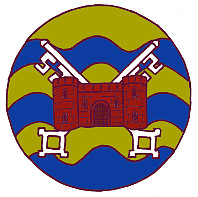 |
The Borough's name is denoted by the stylized castle and waves representing Rhuddlan Castle on the banks of the River Clwyd. The waves are from the arms of the Rhyl UDC and the Prestatyn UDC and the keys refer to St. Asaph. |
|
SOUTH GLAMORGAN COUNTY COUNCIL ~ CYNGOR SIR DE MORGANNWG |
|
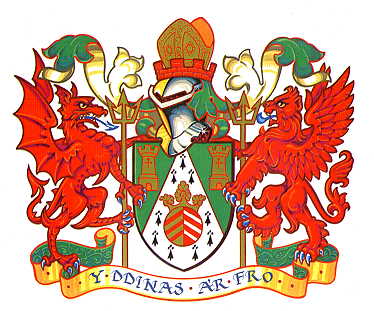
*ARMS: Vert on a Pile reversed throughout Ermine between two Towers Or a Roundel per pale of the last and Gules charged with three Chevronels also per pale Gules and Argent ensigned with an ancient Crown Gold. Motto 'Y DDINAS A'R FRO' - The City and the Vale. |
 |
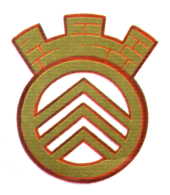 |
The red chevrons on gold are those of the de Clare family, Norman lords of Glamorgan (who made Cardiff the centre of their Lordship), and in the other half the three silver chevrons on red are those attributed to Iestyn ap Gwrgant, the
last Welsh ruler of Morgannwg. The roundel is crowned, as a symbol that it represents the capital city which is contained within the new county. On the ground of the shield the ermine section of the shield refers to the rich valley guarded by castles, which are shown above on either side. |
|
SOUTH PEMBROKESHIRE DISTRICT COUNCIL ~ CYNGOR DOSBARTH DE SIR BENFRO (DYFED) |
|
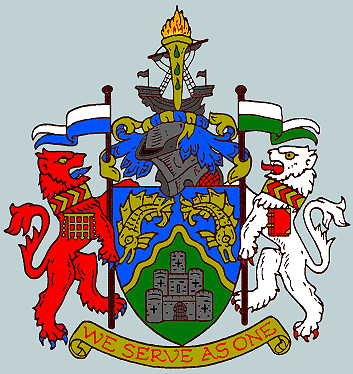
ARMS: Per chevron wavy Azure and Vert a Chevronnel wavy between in chief two Dolphins haurient that to the sinister contournee Or and in base a Castle of three degrees and five towers proper. Motto 'WE SERVE AS ONE'. The South Pembrokeshire District was formed by the amalgamation of the Borough of Pembroke, the Borough of Tenby, the Narberth Urban District, the Narberth Rural District and the Pembroke Rural District. |
 |
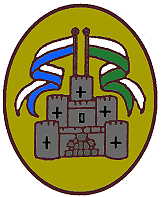 |
The shield represents heraldically the ancient division of Penfro ("the headland") and its joint character as a seaside holiday area and an historic rural area. The blue top half of the shield with two gold dolphins, like the supporters of the Borough of Tenby, represents fishing and coastal resorts. The lower half, suggests the promontory, is green with a gold wavy edge denoting the sandy beaches. The district was governed in medieval times from the historic castles which dominated the promontory; the link between ancient and modern government is suggested by a single castle of five towers symbolizing the union of the five Penfro councils in one authority. |
|
TAFF-ELY BOROUGH COUNCIL ~ CYNGOR BWRDEISTREF TAF-ELAI (MID GLAMORGAN) |
|
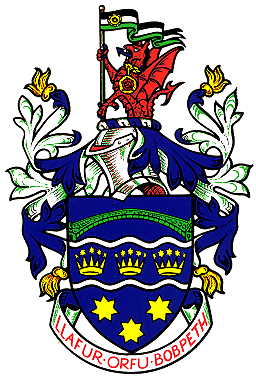
ARMS: Azure between two Barrulets wavy Argent three Celestial Crowns Or in chieT a representation of the Old Bridge at Pontypridd issuant proper and in base three Mullets of seven points two and one Or. Motto 'LLAFUR ORFU BOBPETH' - Hard work conquers everything. The Borough of Taff-Ely was formed by the amalgamation of part the Caerphilly Urban District, the Pontypridd Urban District, part of the Cardiff Rural District, part of the Cowbridge Rural District and the Llantrisant & Llantwit Fardre Rural District. |
 |
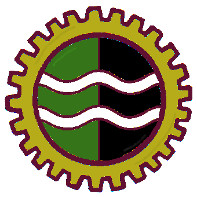 |
Thee shield is a combination of emblems from the arms of the Llantrisant and Llantwit Fardre RDC and the seal of the Pontypridd UDC. The two white waves represent the rivers Taff and Ely which give the Borough its name. Over the top wave stands the Old Bridge of Pontypridd spanning the Taff; the otner wave, running parallel, is the Ely, flowing through the Llantrisant and Llantwit Fardre area. The three golden celestial crowns symbolize Llantrisant, the three Saints, Illtyd, Gwynno and Dyfodwg. The three golden stars denote St. Illtyd, the famous astronomer from whom Llantwit (Llanilltyd) is named. Previously borne with six points, the stars are here given seven to represent the seven additional parts of Caerphilly and Cowbridge RDC which complete the Borough area. The whole is set on a background of blue, appropriate to the symbolism of the crowns and stars. The shield is, in fact, an heraldic map of the area. |
|
WEST GLAMORGAN COUNTY COUNCIL ~ CYNGOR SIR GORLLEWIN MORGANNWG |
|
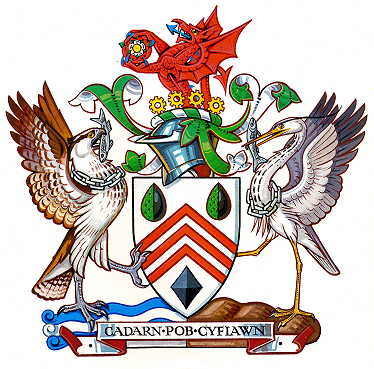
ARMS: Argent three Chevronels Gules between in chief two Pine Cones Vert dimidiating as many Gouttes Sable and in base a Lozenge also Sable. Motto 'CARDARN POB CYFIAWN' - The just are strong. |
 |
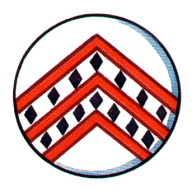 |
The white shield with three red chevronels is based on the traditional arms of the old Princes of Gwyr. The green pine cones refer specifically to the reafforestation projects of the County. The goutte is a liquid drop and is coloured black to symbolise oil with reference to the oil refining and attendant industries. By the combination of these two particular and most convenient allusions and shapes we have a third allusion by way of the union of countryside with urban areas. The third device, a black diamond, represents the coal industry. |
|
WREXHAM MEALOR BOROUGH COUNCIL (CLWYD) See Wrexham County Borough Council. |
|
|
|
|