| EAST RIDING COUNTY COUNCIL |
|
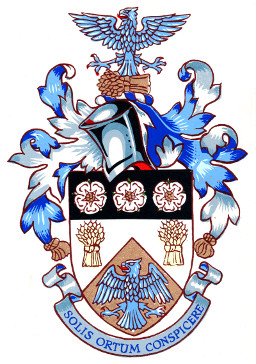
ARMS: Per chevron Argent and Or in chief two Garbs proper and in base an Eagle displayed Azure on a Chief Sable three Roses of the first barbed and seeded proper. Motto 'SOLIS ORTUM CONSPICERE' - To behold the sunrise. |
 |
|
The white roses represent Yorkshire and the wheatsheaves agriculture. The blue eagle was used as an emblem by the County Council before the arms were granted, and was probably derived from the eagle sometimes quartered in the arms of Beverley. |
| HALTEMPRICE URBAN DISTRICT COUNCIL |
|
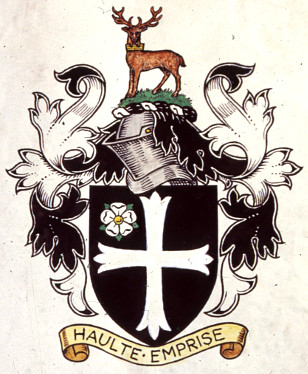
ARMS: Sable a Cross patonce Argent in the first quarter a Rose of the second barbed and seeded proper. Motto 'HAULTE EMPRISE' - High endeavour. |
 |
|
The basic black shield and cross are taken from the arms of Haltemprice Priory (dissolved and demolished by order of King Henry VIII). This foundation gave its name to the Urban District created in 1935 by the amalagamation of the Urban Districts of Hessle and Cottingham and part of the Rural District of Sculcoates. This has been differenced by the addition of a white rose, the County emblem. |
| HOLDERNESS RURAL DISTRICT COUNCIL |
|
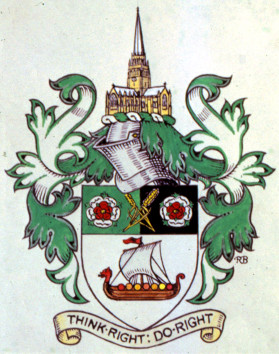
ARMS: Argent a Viking Ship in full sail proper on a Chief per pale Vert and Sable btween two Roses Argent each charged with another Gules all barbed and seed proper two Stalks of Wheat in saltire Or. Motto 'THINK RIGHT DO RIGHT'. Image and information from the Heraldry Society Image Library. |
 |
|
The Viking ship recalls the landing and settlement of the Vikings in the district. The green and black chief and the stalks of wheat allude to agriculture and industry. The combined white and red roses refer to the landing of Henry of Lancaster, later Henry IV in 1399, on his way to dethrone Richard II and the Yorkist Earl of March, later Edward IV in 1471, on his way back from exile in the Netherlands. Both landed at Ravenspurn, which is now lost due to coastal erosion. |
| POCKLINGTON RURAL DISTRICT COUNCIL |
|
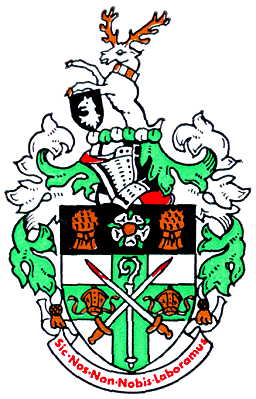
ARMS: Argent on a Cross Vert an Abbot's Crosier in pale of the first between two Mitres in fesse Or over all two Swords in saltire proper embrued Gules hilts and pommels Gold on a Chief Sable a Rose of the first barbed and seed proper between two Garbs also Gold. Motto 'SIC NOS NON NOBIS LABORAMUS' - Thus we labour, but not for ourselves. |
 |
|
The main colours, white and green, refer to the waterways and countryside. The green cross represents two ancient British trackways, Garraby Street (York to Bridlington), and the Norton - Londesborough - Brough road which crosses it. On this cross, the abbot's crosier refers to the religious houses which played an important part in the mediaeval history of the district. It is flanked by two golden mitres, one referring to Bishop Paulinus, who is said to have converted King Edwin
to Christianity at Goodmanham. The other mitre refers to the Archbishop of York, with which the district has many connections. The crossed swords with bloodstained points recall one of the most famous battles in English history, when Harold defeated Tostig and King Harold Hardrada at Stamford Bridge in 1066. The black chief, the white rose of York and the golden wheatsheaves are adapted from the East Riding County Council arms, and also provide an incidental reference to the
agricultural and horticultural societies of the district. The wheatsheaves are appropriate to a rural district and they also occur in the arms used by Pocklington School. |
|
|
|
|